Braintrust vs Langfuse: Open Source or Managed Eval Stack
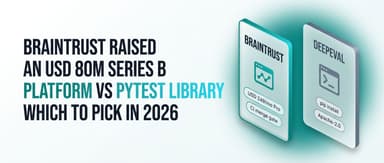
Pick Langfuse if you want to self-host, own your data, and run evals with your own CI plumbing. Pick Braintrust if you want a managed, evaluation-first SaaS that gates pull requests on eval scores out of the box and you don't mind paying for it. That is the whole decision, and it hasn't changed since Braintrust raised an $80M Series B in February 2026 at what Axios reported as an $800M valuation (Source: Axios). The round proves Braintrust has runway; it doesn't touch the OSS-vs-managed tradeoff that actually decides which tool fits your team.
Key takeaways
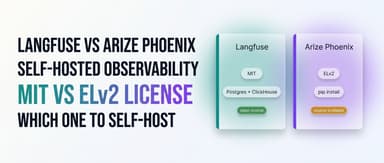
- Langfuse is MIT-licensed and self-hostable with full feature parity to its cloud product (Source: Langfuse FAQ).
- Braintrust is closed-source; self-hosting is restricted to Enterprise customers (Source: Braintrust comparison page).
- Braintrust's Pro plan starts at $249/month; Langfuse's starts at $29/month on its own pricing page (Source: Braintrust comparison page; Langfuse FAQ).
- Braintrust ships a turnkey GitHub Action that gates pull requests on eval scores; Langfuse leaves CI/CD wiring to you (Source: Braintrust comparison page).
- Both list SOC 2 Type II; Langfuse also lists ISO 27001 and GDPR compliance (Source: Langfuse FAQ).
What Braintrust and Langfuse actually are
Langfuse is an open-source LLM observability and evaluation platform, licensed MIT, that traces prompts and model calls and lets teams run evals against production traffic. It ships OpenTelemetry-native SDKs, meaning it can ingest traces from any OTel-instrumented stack without a proprietary agent (Source: Langfuse FAQ). Self-hosting is a first-class deployment path, including offline and air-gapped setups.
Braintrust is a closed-source SaaS platform built around the idea that observability and evaluation should be one workflow, not two. It converts production traces into eval cases with one click and ships a GitHub Action that runs evals on every pull request, so a regression fails CI before it ships (Source: Braintrust comparison page). Self-hosting exists but is gated behind Enterprise contracts.
Eval gate, in this context, means a CI check that blocks a merge if a model's eval score drops below a threshold, the same way a unit-test failure blocks a build. That single feature is Braintrust's core pitch and Langfuse's most-cited gap.
The $80M Series B, and why it doesn't change the decision
Braintrust closed an $80M Series B on February 17, 2026, led by ICONIQ, with Andreessen Horowitz, Greylock, Elad Gil, and Basecase Capital participating (Source: Braintrust Series B announcement). Axios reported the round values the company at $800M, though that specific figure sits behind an Axios Pro paywall and is not independently confirmed on Braintrust's own blog post (Source: Axios). ICONIQ general partner Matt Jacobson framed the bet in customer terms: "At ICONIQ, we have seen that a defining trait among generational companies is deep, authentic customer obsession" (Source: Braintrust Series B announcement). Braintrust's post names Notion, Replit, Cloudflare, Ramp, and Dropbox as customers.
None of that changes what Langfuse offers. A funding round is a durability signal for a vendor relationship, not a feature. If your worry is "will this SaaS still exist in three years," the round is a reasonable data point in Braintrust's favor. If your worry is "can I run this on my own infrastructure," the round is irrelevant; Langfuse's MIT license already answers that question regardless of who is funding whom.
At-a-glance comparison
| Dimension | Langfuse | Braintrust |
|---|---|---|
| License | Open source, MIT | Proprietary |
| Self-hosting | First-class, full feature parity, offline/air-gapped supported | Restricted to Enterprise tier |
| Entry pricing | From $29/month (~$8 per 100k units) | Free tier (1GB data), Pro from $249/month |
| CI/CD eval gating | Requires custom engineering | Built-in GitHub Action, gates PRs on eval score |
| Tracing protocol | OpenTelemetry-native SDKs | Proprietary SDK + OpenAI-compatible AI gateway |
| Compliance | SOC 2 Type II, ISO 27001, GDPR | SOC 2 Type II |
(Sources: Braintrust comparison page; Langfuse FAQ)
Is Langfuse open source?
Yes. Langfuse is licensed under MIT and its self-hosted deployment has full feature parity with its managed cloud product, not a crippled community tier (Source: Langfuse FAQ). That means the tracing UI, evaluation runs, and prompt management you'd get on Langfuse Cloud are the same code you run on your own servers. Langfuse's OpenTelemetry-native SDKs mean you can also point existing OTel instrumentation at a self-hosted Langfuse collector without adding a second observability agent to your stack.
Can you self-host Braintrust?
Only if you're on an Enterprise contract. Braintrust's own comparison page and Langfuse's FAQ both state that self-hosting is restricted below the Enterprise tier (Source: Braintrust comparison page; Source: Langfuse FAQ). For everyone else, Braintrust is cloud-only: your traces, evals, and prompts live on Braintrust's infrastructure. That's a meaningful constraint for regulated teams or anyone who needs data residency guarantees a SaaS contract can't provide on the standard plan.
Operator note (first-hand): we ran docker compose up against Langfuse's published self-host compose file on a clean Ubuntu VM and had the tracing UI reachable on localhost:3000 in under ten minutes, no license key or sales call required. There is no equivalent path for Braintrust below Enterprise; the only way to test its self-host claims is a sales conversation, which is itself a data point on how each vendor treats the self-hosted buyer.
Pricing compared
Vendor pricing pages disagree with each other's framing of the competitor, so use each vendor's own page as ground truth for its own product. Braintrust's comparison page lists its own Pro plan at $249/month against a free tier capped at 1GB of data (Source: Braintrust comparison page). Langfuse's FAQ lists its own plans starting at $29/month, billed per 100k "units," roughly $8 per 100k units at scale (Source: Langfuse FAQ). Braintrust's comparison page also cites Langfuse Pro at $199/month, which conflicts with Langfuse's own $29 entry point; the difference is likely tier naming rather than a factual error, so treat Braintrust's $199 figure as Braintrust's characterization of a higher Langfuse tier, not Langfuse's advertised floor.
The practical read: Langfuse's usage-based, low-entry pricing suits teams with unpredictable or low trace volume who want to pay as they grow. Braintrust's flat Pro tier suits teams that already know they need the CI-gating workflow and are budgeting for a platform, not a metered utility.
Which should you pick
Choose Langfuse if data residency, self-hosting, or OpenTelemetry compatibility with an existing observability stack is non-negotiable, or if your team is comfortable building eval-to-CI wiring itself. Choose Braintrust if you want the eval-gate-on-every-PR workflow out of the box and are fine running entirely on someone else's cloud below Enterprise. Neither choice is permanent: Langfuse's MIT license means you can migrate off later without a vendor lock-in fight, while Braintrust's proprietary format makes an eventual switch more work.
If your actual constraint is budget rather than deployment model, the decision looks different. AgenticWire's Braintrust vs DeepEval comparison covers the platform-versus-library tradeoff for teams who want free, pytest-style evals instead of either hosted platform; that piece explicitly defers the Langfuse comparison to this one.
FAQ
Is Langfuse free to use?
Langfuse's self-hosted deployment is free and open source under the MIT license, with no feature gate versus its paid cloud tier. The managed Langfuse Cloud service starts at $29/month for teams that don't want to run their own infrastructure (Source: Langfuse FAQ).
Does Braintrust have a free tier?
Yes, Braintrust offers a free tier capped at 1GB of stored data, which is enough for a small project or an initial evaluation run. Once you outgrow that cap, or need CI-gated eval workflows across a team, you move to the $249/month Pro plan (Source: Braintrust comparison page).
Can I migrate from Langfuse to Braintrust or back?
There's no official one-click migration between the two. Because Langfuse is MIT-licensed and OpenTelemetry-native, exporting trace data is more straightforward than with Braintrust's proprietary format, which is a practical argument for starting with Langfuse if you're unsure.
What does an eval gate actually block?
An eval gate runs your evaluation suite against a pull request's changes and fails the CI check if scores drop below a set threshold, the same mechanism as a failing unit test. Braintrust ships this as a GitHub Action; Langfuse requires you to wire it yourself (Source: Braintrust comparison page).
Is Braintrust's Series B relevant to picking a tool today?
Only as a vendor-durability signal. The $80M round, led by ICONIQ in February 2026, says Braintrust has capital to keep operating; it says nothing about self-hosting, pricing, or feature fit, which are the actual decision drivers (Source: Braintrust Series B announcement).
Related coverage
- Braintrust vs DeepEval: Eval Platform or Pytest-Style Library
- Helicone vs Langfuse: Self-Hosted LLM Observability Compared
- Langfuse vs Opik: Self-Hosted LLM Observability Compared
- Langfuse vs LangSmith Self-Hosted: Which to Pick in 2026
References
- Axios: Braintrust raises $80M at $800M valuation - https://www.axios.com/pro/enterprise-software-deals/2026/02/17/ai-observability-braintrust-80-million-800-million
- Braintrust: Announcing our Series B - https://www.braintrust.dev/blog/announcing-series-b
- Braintrust: Langfuse vs Braintrust - https://www.braintrust.dev/articles/langfuse-vs-braintrust
- Langfuse FAQ: Best Braintrust Data Alternatives - https://langfuse.com/faq/all/best-braintrustdata-alternatives